
If you’ve tried to answer the question “which AI tool should we use for marketing?” lately, you already know the trap. By the time you’ve finished evaluating the options, a new model has shipped, a competitor has leapfrogged the leader, and the article you bookmarked last quarter is quietly out of date.
There’s no single best AI marketing tool in 2026. The leader changes by category and by month, so the smarter approach is knowing who’s ahead right now in the job you need done.
This is the defining feature of AI marketing tools in 2026: the leaderboard is real, and it changes constantly. So the goal of this piece isn’t to crown a permanent winner, because there isn’t one. It’s to give you a clear map of who’s leading right now in each category, an honest explanation of why that keeps shifting, and a way to make decisions that don’t fall apart the next time someone ships an update.
Why “Best” Is a Moving Target
In most software categories, leadership is sticky. The market leader from three years ago is usually still near the top. AI broke that pattern.
The major AI labs are releasing new flagship models on a roughly monthly cadence, and each release tends to reshuffle the rankings. The frontier models powering most marketing tools (the systems from OpenAI, Anthropic, and Google) have all shipped multiple major versions in the past year alone, each one closing the gap on, or briefly overtaking, the others. A tool that felt clearly ahead in January can feel a step behind by spring, not because it got worse, but because everyone else caught up.
There’s a second reason the ground keeps moving. Most AI marketing tools don’t build their own models, they build a useful layer on top of someone else’s. So when the underlying model improves, every tool sitting on top of it gets better overnight, sometimes without changing a thing about their own product. The capability you’re really buying lives one layer down from the logo on the dashboard.
The practical takeaway: chasing “the single best tool” is a losing game. The smarter question is “which tool is leading at the specific job I need done, and how locked in am I if that changes?”
The Jobs, Not the Brands
The most useful way to think about AI marketing tools in 2026 isn’t by brand. It’s by the job you’re hiring the tool to do. The landscape sorts cleanly into a handful of categories, and the leaders look different in each one.
General-Purpose Assistants (the workhorses)
These are the broad conversational tools (ChatGPT, Claude, and Gemini being the names most teams reach for) that handle the widest range of day-to-day marketing work: drafting, brainstorming, summarizing, editing, research, and increasingly, multi-step tasks run on your behalf. For most teams, one of these is the backbone, and the others are worth keeping around because each pulls ahead on different tasks at different times. They’re close enough, and improving fast enough, that the “leader” among them genuinely depends on the week and the use case.
Content and Copywriting Tools
This is the category built specifically for marketing output: blog drafts, ad variations, email sequences, social posts. Tools here (Jasper, Copy.ai, Writesonic, and Grammarly‘s generative features among them) layer brand voice controls, templates, and team workflows on top of the underlying models. Their edge isn’t raw writing ability, which increasingly comes from the model underneath, it’s the workflow around it: keeping output on-brand, on-format, and easy for a team to manage at volume.
SEO and Content Optimization
A distinct and fast-maturing category focused on helping content rank, in both traditional search and the new AI-driven results. Tools like Clearscope, Surfer, MarketMuse, and Ahrefs‘ AI features help you research topics, optimize drafts against what’s actually ranking, and increasingly track how your brand shows up inside AI answers. This last part, getting cited by ChatGPT, Gemini, and AI Overviews, is the category’s newest frontier and where much of the 2026 innovation is concentrated.
Image and Visual Generation
Where AI’s progress is most visually obvious. Midjourney remains the quality benchmark many designers reach for, while tools built into broader platforms (Adobe’s Firefly, the image features inside the major assistants) win on convenience and rights-cleared output. The gap between “impressive demo” and “usable in a real campaign” has narrowed dramatically, though human direction still separates good output from on-brand output.
All-in-One and Automation Platforms
The category trying to tie it all together, planning, creation, publishing, and analytics in one place, often with automation connecting the steps. This space is the most volatile of all, because the value proposition (one platform to rule them all) is exactly what the general assistants are also racing toward. It’s powerful when it fits your workflow and frustrating when it doesn’t quite.
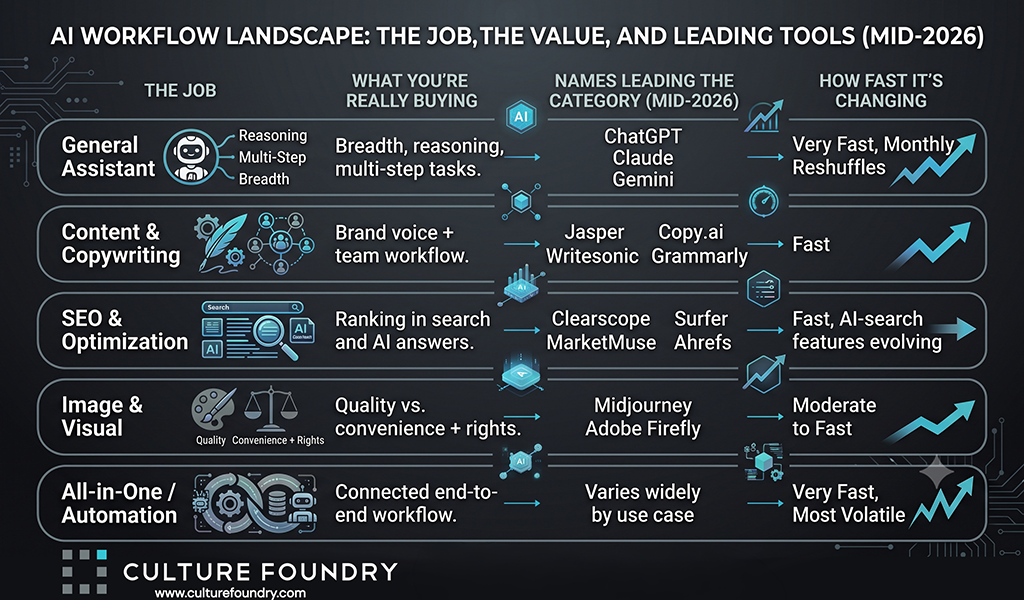
A Snapshot of the AI Marketing Tools 2026 Landscape
A map, not a verdict. Use it to understand the categories, then test against your own work, because the specific leaders will have moved by the time you’re reading this.
| The Job | What You’re Really Buying | Names Leading the Category (mid-2026) | How Fast It’s Changing |
|---|---|---|---|
| General assistant | Breadth, reasoning, multi-step tasks | ChatGPT, Claude, Gemini | Very fast, monthly reshuffles |
| Content & copywriting | Brand voice + team workflow | Jasper, Copy.ai, Writesonic, Grammarly | Fast |
| SEO & optimization | Ranking in search and AI answers | Clearscope, Surfer, MarketMuse, Ahrefs | Fast, AI-search features evolving |
| Image & visual | Quality vs. convenience + rights | Midjourney, Adobe Firefly | Moderate to fast |
| All-in-one / automation | Connected end-to-end workflow | Varies widely by use case | Very fast, most volatile |
Why This Matters Even If You’re Not “Into AI”
It’s tempting to treat this as an arms race for early adopters and wait for things to settle. Two problems with that.
First, your competitors aren’t waiting, and the gains are real. Teams using AI marketing tools well are producing more, testing more variations, and moving from idea to published faster. That compounds. A competitor shipping twice as many campaigns and learning twice as fast isn’t a threat you notice in a single quarter, it’s one you notice after several.
Second, the thing you’re optimizing for has changed. Search itself is being reshaped by AI. A growing share of buyers now get answers from AI assistants and AI-generated search results before they ever click a link. Whether your brand shows up in those answers is becoming as important as where you rank in the traditional results, and the tools that help you measure and influence that are part of this same landscape. Sitting out the AI tooling conversation increasingly means sitting out the visibility conversation.
How to Choose Without Chasing Every Release
The pace is the whole challenge, so build your approach around it instead of against it. A few principles hold up even as the specific tools change:
- Hire for the job, not the hype. Start from the work you actually need done, more content, better-ranking content, faster campaign production, on-brand visuals, and shortlist the category that does that job. A tool that’s “amazing” at something you don’t need is a distraction.
- Favor the layer you can leave. Because so many tools sit on top of the same handful of models, switching costs matter more than features. Prefer tools that let you export your work, your prompts, and your data. The easier a tool is to leave, the safer it is to adopt, because you can upgrade when the leader changes.
- Standardize the workhorse, experiment at the edges. Pick one general assistant as your team’s default so everyone builds shared habits, then stay loose and curious about the specialized tools around it. You get stability where you need it and flexibility where the action is.
- Re-evaluate on a schedule, not on every headline. You don’t need to react to every model release, that way lies whiplash. Set a cadence, quarterly is reasonable, to reassess whether your stack is still the right one. Between reviews, ignore the noise.
- Watch the bills. Per-seat subscriptions and usage-based pricing add up quietly across a team. A periodic audit of what you’re paying for versus what you’re actually using is one of the highest-return hours you’ll spend.
The Real Skill Isn’t Picking the Winner
Here’s the reframe worth holding onto. In a market this fast, the durable advantage isn’t choosing today’s best tool, it’s building a team and a process that can adopt whatever the best tool becomes. The organizations that win with AI aren’t the ones with the perfect stack. They’re the ones who’ve gotten good at evaluating, adopting, and switching, so that when the leaderboard reshuffles, and it will, next month, they capture the upside instead of scrambling to keep up.
The tools will keep changing daily. Your ability to choose well is the thing that compounds.
FAQs About AI Marketing Tools in 2026
What’s the best AI tool for marketing right now?
There’s no single answer, and any specific recommendation will be partly out of date within weeks. The better approach is to identify the job you need done (content, SEO, images, automation) and choose the current leader in that category, prioritizing tools you can leave easily if a better option appears.
Why do the “best” AI tools keep changing?
The major AI labs ship new models on a roughly monthly cadence, and most marketing tools are built on top of those models. When the underlying model improves, the rankings reshuffle, and a tool that led one month can be matched or passed the next.
Should I use one AI tool or several?
Most teams settle on one general-purpose assistant as their default workhorse and add specialized tools for specific jobs like SEO optimization or image generation. Standardizing the core tool builds shared team habits while leaving room to experiment at the edges.
How do I keep up without constantly switching tools?
Re-evaluate your stack on a set cadence, quarterly works well, rather than reacting to every release. Choose tools that make it easy to export your data and work, so you can upgrade when it makes sense instead of being locked in. The goal is a process that adapts, not a stack that never changes.
Does AI tooling affect SEO and search visibility?
Increasingly, yes. A growing share of buyers get answers from AI assistants and AI-generated search results before clicking any link. Whether your brand appears in those answers is becoming as important as traditional rankings, and several tools in this landscape now help you measure and influence that.
Looking for Guidance on Using AI?
AI marketing tools will keep changing; your strategy shouldn’t have to. At Culture Foundry, we help teams cut through the noise. If you’re ready to map your current tools, identify gaps, and design an approach that actually fits your marketing workflow, let’s talk about how we can put the power of AI in your hands.