

Note: This post was originally published in February 2025 and has been updated to reflect current AI-driven search trends as of July 2026.
In 2026, AI (artificial intelligence) search is no longer experimental. It’s how many users start and finish their research, sometimes without even realizing it. Google’s AI Overviews, Chat GPT’s search, Perplexity, and Copilot are using AI-driven models to not just surface search results, but also narrow the field, compare, and sometimes even complete purchases all within the AI interface. For marketers, that means SEO must now account for GEO (generative engine optimization) and visibility to large language models (LLMs), not just traditional SERP (search engine results page) rankings.
The upside: AI tools are improving users’ search experience by making web-based information retrieval more efficient, personalized, and even conversational. Posing a question to an AI chatbot is reminiscent of Marvel Comics’ Tony Stark (a.k.a. Ironman) asking his AI assistant, “J.A.R.V.I.S.” to run a complex computer calculation. It feels like you’re talking to a knowledgeable workmate who understands your question and why you’re asking it.
The downside: The prominence of AI-generated content on SERPs means organic search results are pushed further down the SERP, leading to less exposure and fewer clicks to web pages that aren’t included in the AI-driven search results displayed in the summaries.
Case in point, Google’s AI Overviews, which often appear at the top of a SERP. How often do you see a screen like the one below after typing a search query into Google?
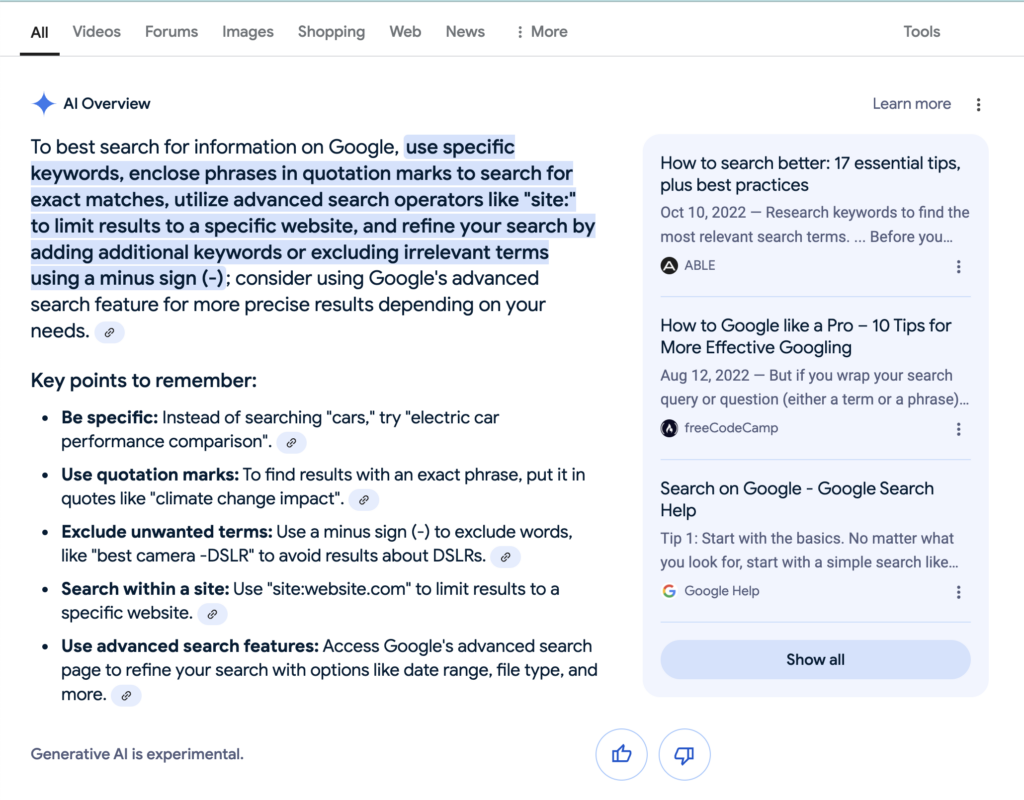
Google’s AI Overviews are an example of AI-driven search content summaries. These summaries are created by analyzing “reputable results” for the search query entered and often include links to the source material. Users receive streamlined responses formatted in short paragraphs, along with a side panel listing the sources referenced. Depending on the complexity of the search, users may find the information they need without scrolling. That can greatly limit users’ exposure to additional search results – and website links – that fall below the AI Overview.
The net of these changes: Users are growing accustomed to search query responses that are curated, specific to their actual questions, and context-aware, meaning the AI software understands the reason why you’re asking the question in the first place, which helps it search the web and cull out the answers most helpful to you. So, if you manage a website and need to get noticed in AI-driven search results, how do you improve the chances a summary includes links to your web content?
In this article we’ll explore how AI is changing traditional SEO strategies and how to create web content engineered to rank in AI-driven search results. We’ll also hear from SEO experts in our network who are embracing this new technology and evolving their guidance.
First, let’s highlight the most popular AI search tools and what they offer.
Popular and Trustworthy AI Search Tools
Not all AI search tools work the same way, and those differences matter if you want your content to show up in them. Some summarize search results, some are built into a whole suite of products, some live right inside a browser. Here’s a rundown of the ones getting the most traffic right now:
- ChatGPT by OpenAI: A conversational AI model that provides detailed responses and engages users in interactive dialogues, aiding in tasks like content creation and answering complex queries.
- Perplexity AI: An “answer engine” that delivers concise responses to user questions by summarizing information from various sources, streamlining the research process.
- Google Gemini and Google AI Overviews: Google’s Gemini is deeply integrated into Google products beyond just the search engine. Gemini is available to assist with Gmail, Google Docs, and Google Sheets, and can be used to complete routine tasks, conduct in-depth research, and generate creative content. In 2026, Google made interface changes to AI Overviews to better highlight inline citations and deliver more results from users’ preferred publishers. It has also updated Google Search Console with reports to help track AI Overview impressions and clicks.
- Copilot Search in Bing: Similar to Google’s AI Overviews, Bing answers questions with concise summaries, visuals, and suggested follow-up questions. It also provides an expandable panel that lists the sources used as well as an option to view the “normal” search results for your query.
What sets these AI tools apart from the technology behind traditional search engines? Robert Cooper, founder of PlusROI Online Marketing, explains the key difference in a recent blog post on Large Language Model Optimization:
Unlike Google, which ranks pages based on keywords, backlinks, and technical metrics, large language models (LLMs) like ChatGPT prioritize context, quality, and comprehensiveness when selecting sources. LLMs aim to answer queries directly by synthesizing information, often without directing users to a particular page. However, they do occasionally cite sources for credibility, especially when answers require specialized expertise or up-to-date information (this will hopefully be especially true with ChatGPT’s new search function). The challenge for marketers and content creators is to make their websites ‘visible’ to these algorithms in a way that values relevance and authority over traditional ranking factors.
– Robert Cooper, Founder, PlusROI Online Marketing
What Is GEO in 2026?
Generative Engine Optimization (GEO) is the practice of making your content easy for any AI models and platforms to understand, trust, and cite. This means structuring your content so that it answers questions, ensuring your metadata consistently tells AI crawlers who you are and what your site is about, and updating your content regularly. GEO doesn’t replace traditional SEO. Instead, it builds on strong technical and on-page SEO and adds AI-specific tactics that help your content get cited and summarized by generative tools.
So, how can you best create and structure your web content to improve its chances of being culled into an AI-generated summary? Or have it referenced in an answer supplied by ChatGPT, Gemini, or Perplexity?
If your web content team is already following good SEO practices, you’re halfway there. According to research conducted by Surfer SEO, 52 percent of sources cited in Google’s AI Overviews already rank in the top 10 search engine results. That means if your web content normally ranks high in SERP, you have a better chance of it being pulled into AI-generated summaries. Additionally, here are specific content development practices you can follow to help capture AI’s attention. Think of it as augmenting your SEO strategy with a GEO (generative engine optimization) equivalent.
Which GEO Strategies Enhance Visibility in AI-Driven Search Results?
1. Optimize Content for AI Summaries
AI tools pull content that answers a question cleanly, without making the reader hunt for it. That means rethinking not just what your page says, but where you say it and how fast you get to the point. Here’s how to get your content noticed:
- Use a Q&A Format: Structure key sections of your content as direct questions and answers (e.g., FAQ pages or blog posts with clear headings like “How is AI Impacting SEO Strategies?”).
- Lead with the Answer: Write succinct, factual responses within the first few sentences before expanding on details. AI prefers clear, straightforward information.
- Employ Bullet Points & Lists: AI often pulls summarized content from well-organized lists or step-by-step guides.
- Include Definitions and Key Facts Early: If writing about a concept, define it in the opening paragraph. Example: “AI-driven SEO is the practice of optimizing content for search engines that use artificial intelligence to rank results.”
- Match the Search Intent: Study the SERPs for the keyword(s) you are targeting before crafting your content, and tailor it to answer the questions you know users (and your target customers) are entering into search engines.
- Update Mission-Critical Content: Information about your products, services, strategies, team, and mission should be updated continuously, so any content pulled into AI-driven search summaries accurately reflects your business and brand.
- Emphasize On-Page Optimization: Remember to follow SEO best practices when it comes to creating page title tags, meta descriptions, headings, alt text for images, URL structure, and internal linking.
- Monitor Google’s AI Overviews & Featured Snippets: Search your primary keywords and analyze how AI is currently summarizing information. Adjust your content to match or improve upon those summaries.
2. Implement Structured Data
Schema markup may sound technical, but it’s really just a way to tell AI crawlers exactly what they’re looking for instead of forcing them to guess. Get it right, and you’ll have more control over what’s cited; get it wrong (or skip it) and you’re leaving AI to make assumptions (or worse – hallucinate) about your business. Start here:
- Add a Brand/Organization Schema: This tells AI engines exactly who you are: your name, description, and official logo. Don’t let them guess at this!
- Add FAQ Schema: If your page includes frequently asked questions, use FAQ schema markup so AI can recognize and extract those answers.
- Use How-To Schema for Tutorials: If your content includes step-by-step instructions, applying how-to schema makes it easier for AI to generate a summary.
- Apply Product Schema for Ecommerce: If selling products, use product schema to enhance visibility in AI-powered search results. Product reviews, pricing, and availability can all appear in AI-generated results.
- Test Your Schema Markup: Use Google’s Rich Results Test to check if your structured data is properly implemented.
3. Follow “E-E-A-T” Principles
Demonstrate “Experience, Expertise, Authority, and Trustworthiness” by creating high-quality, well-researched (and cited), conversational content that is updated regularly to maintain its relevance. This is even more important now that so much content is AI-generated. People (and AI) look for real-life experience from real people. Here’s how to build those signals into your content:
- Author Bios and Credentials: Include author names, credentials, and links to social media or authoritative sites to reinforce expertise.
- Cite Reliable Sources: Link to studies, government sites, or expert publications to back up claims and improve credibility.
- Encourage User Reviews and Testimonials: Positive reviews on platforms like Google Business Profile and G2 can enhance credibility and improve AI ranking.
- Keep Content Up-to-Date: Refresh older posts with new data, examples, and recent industry trends to remain relevant in AI-driven search, and remove content that is obsolete and should no longer appear in search results.
- Build Internal and External Links: Reference related blog posts, case studies, or external sources that validate your expertise.
4. Incentivize User Engagement
AI models have the entire internet at their disposal, so they’re always looking or signals that you’re trustworthy. One of those signals is how people interact with your content: time on page, original comments, and repeat visits all signal your site is useful. These engagement signals help your site stand out in AI-driven search results, not just traditional SERPs. A few ways to build that in:
- Create Interactive FAQs: Allow users to submit questions and receive AI-generated responses based on your content.
- Build Industry-Specific Tools: For example, incorporate a “wine club membership calculator” for wineries or a “website redesign cost estimator” for web design agencies.
- Use Video and Multimedia: AI prefers diverse content formats. Embedding videos with transcripts improves ranking and engagement.
- Optimize for Voice Search: Structure content conversationally to match voice search queries. For example, how would you craft a paragraph to succinctly answer this question: “What’s the best way to get my website noticed by AI in online searches?”
- Encourage User Comments: AI considers user interactions (comments, discussions) as a sign of content value.
- Encourage Branded Search and Direct Visits: When people search for your brand, or repeatedly return to your site, it sends signals that you’re trustworthy. Don’t be afraid to promote your brand through email, social, and digital communities, because the more people seek you out by name, the more AI treats you as an authority
5. Prioritize Responsiveness and Mobile Compatibility
Most searches happen on a phone, and AI crawlers default to indexing the mobile version of your site. But most marketers use a computer at work, so it’s easy to overlook a slow, clunky, or misaligned mobile experience. You want to ensure you’re not handing AI an ugly version of your site. Here’s what to check:
- Use a Mobile-First Design Approach: Google’s search algorithms prioritize mobile-optimized websites through mobile-first indexing, so it’s vital that text, images, and interactive elements display properly across all screen sizes. For example: If users need to pinch and zoom to read your content, your site isn’t truly mobile-friendly.
- Improve Page Load Speed: AI-driven search engines factor in page speed for ranking. A slow-loading site will reduce the chances of being featured in AI-generated results. Use tools like Google PageSpeed Insights to analyze and improve performance. Compress images, enable browser caching, and use a Content Delivery Network (CDN) to speed up load times.
- Ensure AI Can Crawl and Index Your Mobile Site Properly: Some mobile versions of sites unintentionally block AI crawlers due to improper robots.txt configurations. Use Google’s Lighthouse web page assessment tool to check if your site is mobile-accessible.
- Use Responsive Images and Scalable Media: AI favors websites that provide an optimal experience across all devices. One way to ensure your site is responsive is by implementing CSS media queries to automatically adjust images and videos based on screen size. For example, a large desktop banner automatically becomes a smaller, more readable hero image on mobile.
- Optimize for Mobile Voice Search: AI-driven search engines like Google and Bing increasingly rely on voice search queries, which tend to be longer and more conversational. Structure content using natural language and question-based headings (e.g., “How can I improve my website’s mobile speed?”) and leverage FAQ schema to increase the likelihood of being picked up in AI-generated search results for voice searches.
- Reduce Pop-Ups and Intrusive Elements: Google penalizes sites with intrusive mobile interstitials (e.g., pop-ups that obscure content), so avoid them or deploy them strategically as a means to create conversion shortcuts. For example, rather than a full-screen pop-up, use a slide-in call-to-action graphic or button that doesn’t block key content.
- Test Your Site on Real Devices: AI-driven search engines prefer sites that offer a seamless mobile experience. Rather than relying solely on emulators, test your website using real smartphones and tablets to check layout and usability.
6. Monitor AI Performance
Just like SEO, GEO isn’t set-it-and-forget-it. AI models change often, and tactics that worked last month may already be outdated. Go beyond the basic rank tracking and see if and how AI tools are citing you, sending traffic, and even getting the basic facts right. Here’s how to keep tabs on things:
- Use Google Search Console’s “Search Appearance” Reports: Identify if your content is appearing in AI Overviews or featured snippets.
- Track Click-Through Rate (CTR) Changes: If AI summaries are reducing your traffic, adjust content titles and meta descriptions to make your links more enticing.
- Experiment with AI-Specific Queries: Use tools like AnswerThePublic or AlsoAsked to find questions AI might be prioritizing in search.
- Monitor AI Chatbot Referrals: Some AI-powered search engines (e.g., Perplexity, Microsoft Copilot) may start directing traffic to your web pages. Check referral sources in Google Analytics or Microsoft Clarity.
- A/B Test Content Formats: Compare the performance of different content types (e.g., FAQs vs. long-form guides vs. interactive tools) to see what ranks higher in AI-generated results.
- Run Periodic “AI Visibility Audits”: You likely already monitor your standings in search results. Do the same for the most popular AI platforms. Do they mention you when you search for your core topics? What do they say about you? Is it accurate?
Acquiring Customers Through AI Search Channels
With the challenge of navigating AI’s influence in search results comes the opportunity to tip the scales in your content’s favor by implementing a GEO strategy that supports your SEO one. Optimize your content for AI algorithms to increase your visibility, reach more prospective customers, and leverage this new technology to improve your digital marketing.
As Fire&Spark CEO Dale Bertrand recently shared on Kevin Lee’s Power of Marketing podcast, it’s always smart to fish where the fish are and be ready to adapt.
When it comes to your customers, you as a marketer need to be where your customers are at—full stop. So, where are they searching for the type of product or service that you sell, or the questions that you answer?
“The first thing is understanding what your visibility is now, thinking about what types of searches you want to show up for. And then also understanding that these are conversations not ‘searches,’ so what types of conversations do you want to be mentioned in? Then test it out on a variety of different platforms.
-Dale Bertrand, CEO Fire&Spark
How to Make AI-Generated Searches Work for You
If you need help creating or evolving web content to make it more likely to appear in AI-generated search results, we have a network of SEO and GEO experts ready to assist. Let’s chat!