

The end of 2025 marks the end of EcoSoul Partners, a climate startup venture that I was honored to co-found with Trevor Dodd (Culture Foundry cofounder and CCO) and David Skinner (Culture Foundry COO) in 2020.
The general advice digital agency leaders get when considering a spinoff venture is: “Don’t do it under any circumstances, unless it’s the 1% case where it will truly break out, in which case definitely do it.” Carl Smith of The Bureau had the most nuanced not-quite-advice to offer: “I hope for you that it’s either an amazing success or a quick and clear failure.” Five years later, I know exactly what he meant.

Origin Story: Carbon Credit Cart
EcoSoul Partners was originally founded as Carbon Credit Cart in 2020 (spoiler alert: pivot ahead), sparked by a problem at Culture Foundry that we had no clear means to solve: a quick and easy way to include climate-impact accounting in our bottom line.
The inciting event was a planned company offsite in Austin, Texas, for our distributed team, and we wanted to start the event with a declaration of its carbon neutrality via offsets. The problem: We had no idea how to do that or how much it would cost.
Serendipitously, I soon met one of the foremost experts in the field, Wolf Lichtenstein of Evergreen Carbon, at a Bloomberg Green conference in Seattle. I ran the scenario by him: For our company offsite (3 days, 12 people, 9 round-trip flights, 48 hotel nights, plus cabs, meals, etc.) what sort of expense was I looking at for carbon credits to offset the whole thing? I braced for impact: $2,000? $20,000? Wolf did some quick math: probably around $350. The process to secure them was a bit esoteric, but he’d be happy to do so on our behalf.
Sold! I was also agog at how off my assumptions had been. If people only knew how inexpensive carbon credits were – and also had an easy way to find and buy them – wouldn’t everyone do it? Meanwhile, purveyors of credits, who typically sold to clients directly, lacked an accessible public marketplace, particularly at lower volumes. Opportunity wise, this felt like a “run don’t walk” moment. David and Trevor agreed and Carbon Credit Cart was born.
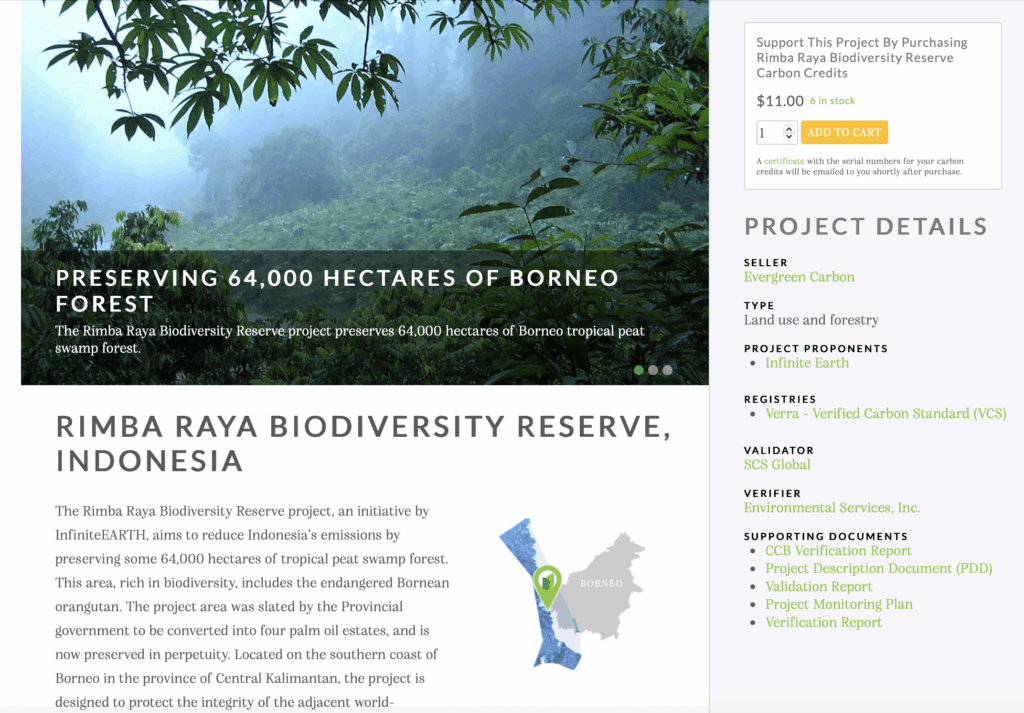
Interest in the venture was instant, intense, and energizing. It took about six months to launch a Culture Foundry-built ecommerce platform and we were soon racking up both sales and meetings. With Evergreen Carbon as our launch partner, we focused on carbon credits attached to climate mitigation projects with high validity, attractive pricing, and the bones of a good story. Doors flew open. Everyone wanted to learn more.
It was a heady start. Two years in, however, we hit a plateau.
The surge of interest in carbon credits drew a dedicated community of people inspired by the new opportunities to help the planet, but the field’s self-regulated structure meant that bad actors soon found their own opportunities as well. The resulting scandals made for a great story, and the media was quick to pounce. While bad practices had accrued in some quarters, the reputational damage was indiscriminate and left the whole industry – one in which the vast majority of people had been trying their level best to do the right thing – reeling.
Even before carbon credits’ sudden reputational turn, however, it became increasingly clear that people wanted more climate mitigation tools than just carbon credits. Doubling down on “trustworthy credits” was not going to be enough.
While these emerging headwinds were sobering, we also had the benefit of a good amount of data on who our most resilient and regular customers were, which proved to be small and medium sized businesses (SMBs).
It was time to pivot.

EcoSoul Partners
In 2023 Carbon Credit Cart became EcoSoul Partners, focused on climate action for business. The core platform remained intact, but the primary business model was now a membership one, targeted at SMBs who wanted to be part of the solution but lacked the resources to incorporate an integral climate mitigation initiative on their own.
Many SMBs who had pursued this path were stuck in a familiar trap: They had commissioned a detailed climate impact study for their business (typically costing $20,000 – $40,000) but on receiving it, were unclear on next steps. Weeks would turn into months, eventually turning into the need to do a fresh study and start over. Major frustration.
By contrast, EcoSoul Partners posited that within a sector, climate impacts could be gleaned from industry data and a simple set of company-specific variables. This dropped complexity and cost dramatically. How dramatically? Knock a couple of zeroes off those numbers above and you’re in the neighborhood. Let’s go!
And we did go… right into the teeth of a target market that had gone from bad to worse. The wave of disfavor around carbon credits had turned into an entire tide against climate change mitigation efforts as a whole. Climate? Out. AI? In!
In addition, while large companies were riding high (high enough to fund their own climate impact initiatives, though that tide was turning too), 2023-2025 saw tightening economics for most SMBs, reducing the priority of climate considerations from “core value” to “luxury we cannot afford.”
Oh, there was still talk of climate impact in the business community, but the other rude awakening as we switched from a retail model to a more consultative model was that the gap between “talking climate solutions” and “committing to climate solutions” was for a typical company about Grand Canyon wide. High enthusiasm from frontline contacts on initial introductions made us think we had landed the pivot well, but that enthusiasm cooled quickly as discussions moved up the decision chain, leading to a lot of expensive “no”s.
Cut to the climate startup’s cofounders powering the venture with their time, attention, energy and money – and taking a hard look at its fifth year. We’d doubled down on the first pivot. After a frank assessment of the landscape and our own resource stores and competing commitments, we determined that we didn’t have another pivot in us.
A Climate Startup: Lessons Learned
1. However you package it, very few will actually pay the “green premium.”
If it’s not an absolute business imperative, the person authorizing the budgets is going to be a “no” 99% of the time, no matter how enthusiastic your initial conversations and no matter how “green forward” the company may present itself.
2. Trust has cratered everywhere.
It’s not just the low-hanging fruit of carbon credit scandals (and the entertainingly gleeful takedowns thereof). It’s tech. It’s business. It’s politics. Everywhere people have taken the bait of the promise of a better world in the past few years, they’ve gotten burned. It’s left a mark, and if that’s a key part of your story, expect a tough room.
3. Seeking the moral high ground on the Titanic is a bad survival play.
Having spent five years in the thick of the arguments around the climate crisis, there’s one where I’ve hit the “I’m just gonna stop you there” wall. You’ve heard it as well: some variant of “well, Al Gore <or other climate persona> has air conditioning or took a flight once, so all their attempts to help with the climate crisis are hereby rendered invalid.” So yeah, point granted; I guess we’ll all just get back to our regularly scheduled burning to death now? How is that line of argument helping in any way? If people want to help, welcome the help.
Green Shoots and Shoutouts
Our journey into the broader market of “typical” companies led us to meet some atypical, exceptional and committed companies and people along the way: ones who continue to walk the walk in their determination to be part of the climate crisis solution. Some green shoutouts:
- Trevor Dodd and David Skinner, intrepid EcoSoul cofounders.
- Wolf Lichtenstein and Evergreen Carbon; Wolf’s experience in this field dates to before most people even knew it was a field, and his commitment runs to bedrock. If you need carbon credits, Evergreen Carbon is the place to find them.
- Jessica Uhlig Henderson and Kari Huus, for adding their exceptional talents to the venture and team.
- Trent Hein of Rule4, Sarah Ann Gilbert, Kristen Gilson, and Linda Lannen for committing real financial, political and / or social capital to the cause.
- Ivan Stegic of Ten7 and Dani Vachon of The Beacon Design Collective, who were already ahead of the curve by including carbon / environmental credits as an employee benefit.
- Bryan Lawrence, for applying his razor-sharp SEO expertise to help us track down and fix a thorny SEO issue after the pivot.
- Bill Gottlieb for his thoughtful and direct advice on both sides of the venture.
- Tom Chi and At One Ventures, who in all my climate conversations in the last five years have evidenced the most clear-eyed and promising views of the climate venture space and the opportunity it presents. They understand the “unit economics over green premiums” imperative completely. Watch that space.
- Patagonia, for showing other companies what successful climate leadership looks like.
Regrets?
None. Ventures fail all the time and you miss 100% of the shots you don’t take. It’s not my first climate startup venture and won’t be my last, because what was true in 2020 remains true today: The climate crisis is the defining issue of our time, and addressing it is going to require repeated and resilient effort from every quarter. Thanks to all who joined us for the EcoSoul Partners chapter of the journey.