
From the Conference Stage to Your Digital Strategy
I had the opportunity to present a session titled “Site archi-what? Taxono-who? Build the web foundation you’ll need — for AI, SEO and everything else” at the 2025 Digital Collegium Annual Conference in Grand Rapids, Michigan.
The room was full of marketing and digital leaders eager to explore how artificial intelligence (AI) and search engine optimization (SEO) could elevate their web presence. But as we dug in, a recurring challenge emerged: many of these organizations were trying to build advanced capabilities on unstable ground.
As I said during the talk, “AI and SEO can only build on what already exists. If your site’s foundation is weak, every layer you add will wobble.”
That truth lies at the heart of this article — and of Culture Foundry’s approach to sustainable digital growth. Because while it’s tempting to chase new tools or redesign trends, real success starts with the structure underneath everything else: information architecture and taxonomy.

Why Your Digital Foundation Determines Everything
Your website is the digital engine of your organization. It powers your marketing, your storytelling, and your customer experience. But if its foundation — the way content and navigation are structured — isn’t sound, everything that depends on it suffers.
Poor information architecture shows up as confusing menus, redundant content, sluggish workflows, and disappointing analytics. SEO underperforms, AI tools deliver irrelevant results, and internal teams waste hours searching for their own materials.
The irony is that these symptoms often lead to redesigns or new tools when the real problem is structural. Just like a house built on sand, no amount of paint or furniture can fix a weak foundation.
At Culture Foundry, we believe digital excellence starts by getting that foundation right.
What “Information Architecture” and “Taxonomy” Really Mean (and Why They Matter)
Let’s decode the jargon. Information Architecture (IA) is how you organize, structure, and label your site’s content so people — and machines — can understand it. Taxonomy is the system that defines what you call things — the categories, tags, and relationships that connect your content together.
Think of IA as your building’s blueprint and taxonomy as the signage that helps people find their way inside. When done right, these two elements make your site easier to navigate, faster to maintain, and ready for whatever comes next — whether that’s a redesign, new integration, or an AI-powered recommendation engine.
As I shared in the talk: “The better your taxonomy, the more your content becomes data. And when your content becomes data, AI can finally do something useful with it.”
Why Marketers Should Care About Information Architecture
For marketing leaders, IA might feel like an “IT problem.” But in reality, it’s a growth problem. When your content is organized intuitively and semantically, everything works better: SEO improves, AI tools perform better, and users find what they need faster.
A strong information architecture ties measurable ROI, brand credibility, and speed to market together — the exact goals that matter most for modern marketing leaders.
What changes when your content is well-structured?
- Better SEO
- Clearer analytics
- Faster publishing
- Consistent branding
- Smarter AI responses
Common Warning Signs of a Weak Information Architecture
Not sure whether your website has a solid structure? Look for these telltale signs:
- You have great content, but no one can find it.
- Different teams use different naming conventions for similar content.
- Adding a new section or campaign causes confusion or broken links.
- SEO metrics plateau despite ongoing optimization.
- Your AI tools or chatbots produce inconsistent or irrelevant results.
If any of these sound familiar, your challenge isn’t strategy — it’s structure.
Building a Scalable Structure:
Culture Foundry’s Information Architecture Framework
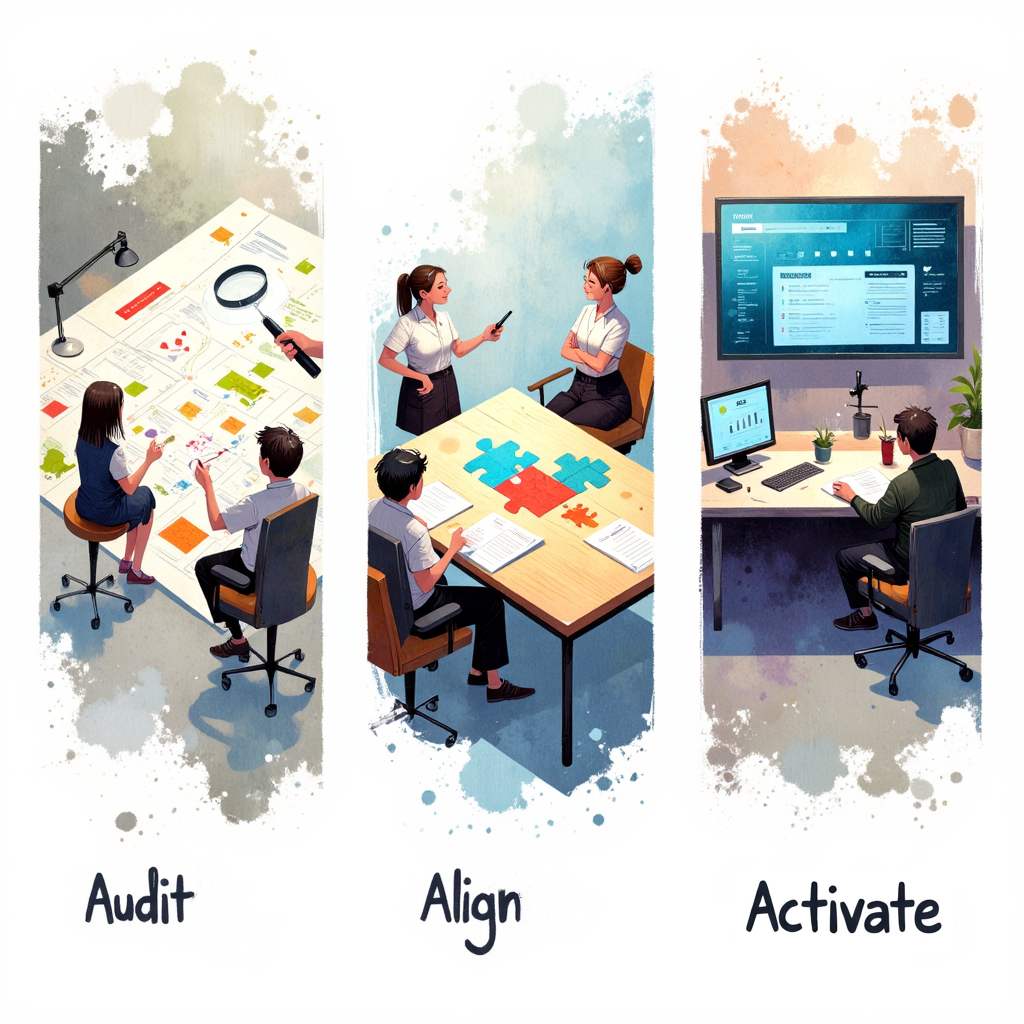
At Culture Foundry, we use a three-part framework to help organizations strengthen their digital foundation:
- Audit – We begin by mapping your existing content structure to uncover redundancies and pain points.
- Align – We work with your team to reorganize content around audience needs and business goals.
- Activate – We implement taxonomy, metadata, and governance systems that power scalability, analytics, and AI readiness.
As I shared at the conference: “Think of your website as a living ecosystem. Information architecture is the root system that feeds everything above the surface.”
The ROI of Getting Information Architecture Right
When structure is sound, results follow.
For one higher-education organization, clarifying taxonomy and content models reduced duplicate content by 60%, increased on-site search satisfaction, and cut the next redesign scope in half.
That’s the power of structure, measurable, sustainable improvement.
Information Architecture: The Bridge to AI
AI doesn’t create structure; it depends on it.
If your taxonomy is inconsistent or your metadata is incomplete, AI tools will reflect that confusion back to you. But when your IA and taxonomy are well defined, your content becomes legible to both humans and machines.
As I told the Digital Collegium audience: “AI doesn’t replace structure; it rewards it.”

Build the Foundation Before You Scale
Before your next redesign, AI rollout, or content expansion, ask: “Is our content organized for growth?” Investing in IA and taxonomy now will accelerate every future initiative — from SEO to automation — and build a digital foundation that will power whatever comes next.